Strategizing from 7 cities across the globe

Who Is Really Sovereign during War Times?
In times of war, sovereignty shifts from an abstract legal status to a fragile, high stakes struggle for control and legitimacy. While it technically means "supreme authority within a territory," war puts this definition through a brutal stress test.
LAWINTERNATIONAL RELATIONSWARMIDDLE EASTPOLITICSUS POLITICSDEMOCRACY
Marina Daniel
3/3/20264 min read
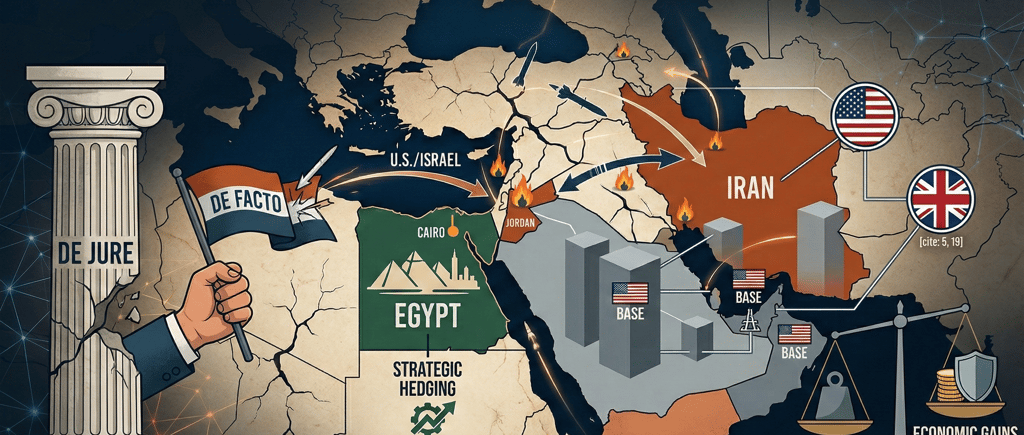
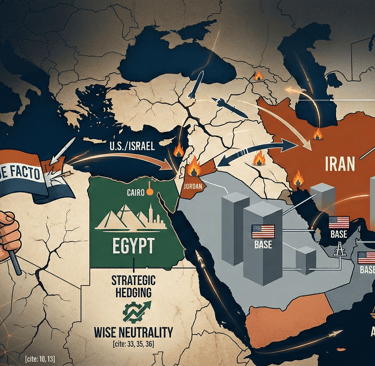
On February 28th, 2026, Israel and the United States launched a series of strikes against Iran. While the conflict was initially confined to these three powers, it was not long until Gulf countries like the United Arab Emirates, Bahrain, the Kingdom of Saudi Arabia, Oman, Kuwait, and Qatar, among other regional Arab states such as Iraq, Lebanon, Jordan, and Syria were dragged in[1]. The United Kingdom, Germany and France have also shown support and acceptance to take part in the war, siding with the United States and Israel against Iran, while Yemen and North Korea expressed their will to side with Iran. Originally, Iran's involvement in the Gulf countries was said to be aimed at United States bases located there. However, it subsequently intensified, expanding to include attacks against civilian areas.
With the official break of an apparent World War, it is of momentous importance to look into the original understandings and realities of terms like sovereignty, hegemony and security.
What does Sovereignty truly mean in times of war?
In times of war, sovereignty shifts from an abstract legal status to a fragile, high stakes struggle for control and legitimacy. While it technically means "supreme authority within a territory," war puts this definition through a brutal stress test. There is a clear gap between de jure and de facto practices and exercise of power. A state may have the legal right to rule (de jure), but if an enemy army occupies its capital, it lacks the factual ability (de facto) to exercise that power.
What happens if a state loses the de facto ability to exercise power?
When a state loses the de facto (practical, actual) ability to exercise power, it undergoes a process known as state failure or collapse. While the state may still legally exist in the international system (de jure), it ceases to function in reality, leading to a void filled by non-state actors, criminality, and severe insecurity. Telhami (2007) goes further to suggest that non-state actors thrive best in an environment where state central authority is weak.[2] During war, power is fragmented among warlords, militias, gangs, or foreign actors.
Do United States military bases in foreign countries undermine national sovereignty?
The presence of foreign troops is, by definition, an "external actor" within that structure. It is also worth mentioning that a host nation may become a target for the U.S.'s adversaries. Host nations may suffer from entrapment, or pressure, to support U.S. military actions, such as drone strikes or invasions to maintain the security relationship, even if those actions contradict their own national interests. From a security perspective, it can be claimed that hosting U.S. troops can lead to an increase in a host country's own defense spending or a higher likelihood of being involved in regional disputes.
What is in it for countries hosting U.S. or other countries’ military bases?
While the presence of U.S. bases is often viewed through the lens of lost autonomy, many host nations actively seek these installations because they provide significant strategic, economic, and political "rent." The most prominent benefit is the defense guarantee. By hosting the troops of a strong country, a country essentially integrates itself into the U.S. military infrastructure, which serves as a massive deterrent against regional rivals. It also saves cost for the domestic military, as it ensures that the existing foreign troops would back its host in case of war or invasion. There are, in addition, several economic benefits, as those bases employ thousands of local civilians like technicians, administrative staff, and service workers. For instance, the U.S. military often sources construction materials, food, and utilities from local vendors, injecting millions into the local economy.
Who is really sovereign in wartimes?
Countries that host no foreign troops maintain absolute legal sovereignty, but they face different wartime risks like the loss of protection from a superpower. These countries should fully rely on their own power. They should also maintain a massive citizen army and "fortress" geography precisely because they know that without a foreign base, no one is coming to help them if their sovereignty is violated.
Let us take Egypt as an example. Egypt is extremely sensitive about its national sovereignty due to its history with British colonial occupation. Consequently, it has a firm policy against allowing foreign countries to establish permanent military bases on its soil. Egypt’s approach to military power in 2026 is a masterclass in "Strategic Hedging”. By refusing to host permanent U.S. bases while simultaneously maintaining a top-tier alliance with Washington, Egypt has carved out a unique position of "Wise Neutrality."
Egypt’s greatest strength is that it no longer relies on any one country for its survival. If one ally tries to pressure Cairo, the Egyptian military simply turns to another. Egypt has shifted from being a "buyer" to a "builder." The Ministry of Military Production’s 2025/2026 budget focuses heavily on Localizing Advanced Technology. Egypt’s budget for FY 2025-26 allocates 252.8 billion Egyptian pounds to investments in the transformational industries sector, a 154 percent increase from 2023/24.[3]
In conclusion, in the modern era, sovereignty is rarely "all or none." Instead, it has become a tradable asset. Host countries accept diminished legal sovereignty in return for economic gains and security in case of foreign attacks.
download the full document
references:
[1] Bronner, L. and Golshiri, G. (2026). Israel and the US attack Iran: What happened in the first hours of bombing. Le Monde. Retrieved from: https://www.lemonde.fr/en/international/article/2026/02/28/israel-and-the-us-attack-iran-what-happened-in-the-first-hours-of-bombing_6750958_4.html
[2] Telhami, S. (2007). Lebanese Identity and Israeli Security in the Shadows of the 2006 War. Current History (1941), 106(696), 21–26. Retrieved fr https://doi.org/10.1525/curh.2007.106.696.21
[3] Anwar, A. (2025). Egypt targets major industrial expansion in 2025/26 plan. Amwal El Ghad Newspaper. Retrieved from: https://en.amwalalghad.com/egypt-targets-major-industrial-expansion-in-2025-26-plan/