Strategizing from 7 cities across the globe

The Integration of AI in Aesthetic and Reconstructive Surgery
Maria Baroud
Edited by: Sara Attie


Introduction
In recent years, the integration of Artificial Intelligence (AI) into medicine has revolutionized diagnostic accuracy, therapeutic planning, and patient-centered care. As healthcare systems increasingly utilize modern technologies, AI has emerged as a powerful agent of change across most medical specialties. Among these, plastic and reconstructive surgery is at the forefront of innovation, benefiting from an enhanced AI-driven precision and predictive capability. Although classical and conventional surgical skills cannot be discarded, the integration of AI tools introduces new possibilities to clinical decision-making that extend beyond human intuition alone.
Plastic and reconstructive surgery uniquely bridge the restoration of form and function, healing both the body and the psyche, and prioritizing holistic patient recovery. It also strongly impacts a patient’s self-image and confidence. For these reasons, there exists a very high demand for accuracy, safety, and predictability in both aesthetic procedures and reconstructive work for trauma or congenital defects. Thus, AI tools like facial mapping systems, machine outcome prediction softwares, and robot-assisted surgeries have been designed and engineered to satisfy these expectations, to achieve anticipated results and, most importantly, to minimize human error. While the use of AI tools in plastic and reconstructive surgery offers promising potential, the expanding use of these machines raises significant ethical and clinical concerns including patient privacy, data security, and technical errors. These issues do indeed challenge the ethical foundations of medical practice.
By examining how AI machines impact surgical procedures, outcomes, and patient experiences, this paper aims to provide a balanced perspective of how technological advancements can be incorporated responsibly into clinical practices.
Background: The Technological Evolution in Plastic Surgery
Over the past century, plastic surgery has significantly evolved, transitioning from a field predominantly centered around reconstructive procedures, to one encompassing sophisticated and advanced aesthetic interventions. For instance, conventional surgical planning previously relied heavily on clinical expertise, anatomical understanding, and manual assessment. Although these methods remain effective today, they have become limited by human subjectivity and error.
However, today, AI machines have been trained using large datasets of medical images, thus allowing them to assist surgeons in optimizing surgical procedures. There is no doubt that this technological evolution reflects a larger shift toward novel approaches to medicine, where treatment is tailored to individual patients instead of relying on generalized protocols.
Pre-Operative Benefits: Facial Mapping
To demonstrate the role of AI tools in plastic and reconstructive surgery, its utilization may be split into three phases or categories: pre-operative, intra-operative, and post-operative. At the pre-operative stage, AI tools improve planning through enhanced facial analysis. 3D visualizations and simulations have become widespread and are being used by plastic surgeons to enable patients to visualize achievable postoperative outcomes, thus aligning expectations before surgery. To understand how AI-driven facial mapping works, these systems operate based on patient scans and convert them into 3D models that can be manipulated to obtain a preview image post-surgery.
For example, traditional surgical planning for rhinoplasty depends on manual examinations. However, in recent years and with the advancement of AI technologies, surgeons have been utilizing a platform called Crisalix 3D. It is a cloud-based, user-friendly 3D simulation system used in rhinoplasty in order to minimize discrepancies between patients’ expectations and the real outcomes, helping increase patient satisfaction (Yamamichi et al.).
A study including patients who underwent aesthetic rhinoplasty between January 2022 and January 2024 was conducted to test the efficiency of Crisalix 3D. The photographs taken were standardized with each patient seated upright, gazing to a fixed point, and with a neutral expression. The camera was positioned 1.5 meters away at nose level to ensure full visibility of the face, forehead, and neck. Then, each image was uploaded to Crisalix 3D software and a 3D model was obtained, tailored specifically for each patient.
Each model showed detailed morphological measurements of the patient’s face including detailed horizontal and vertical proportions. After surgery was performed, according to the proportions provided by the 3D simulator, a questionnaire was as sent to all of the patients to assess their level of satisfaction. The results showed that patients were happy with their outcomes and the numerical results were as follows:
· Satisfaction with the nose increased from a preoperative mean of 39.0 (±8.4) to 74.8 (±21.3).
· Satisfaction with facial appearance improved from 39.5 (±7.5) to 54.8 (±15.1).
· Psychological function rose from 46.2 (±10.3) to 52.3 (±11.6). (Yamamichi et al.)
Hence, AI- driven facial mapping tools utilized in plastic surgery procedures help guide surgical decisions and estimate post-surgical outcomes, achieving and satisfying results.
Furthermore, tools like Virtual Reality technologies (VR) have also emerged in an attempt to enhance pre-operative planning and in intra-operative guidance in various breast reconstructive surgeries. VR technologies convert scans into AI-driven 3D environments that aid surgeons in preparing for various surgeries using a patient-specific model. These VR tools give insight into a patient’s anatomy before surgery even starts through an algorithm that detects subcutaneous fat and muscle. One example of this VR technology is ImmersiveView VR, where “all the necessary landmarks, structures, surgical steps, and positional control points are incorporated into this model or plan” (Novotny et Al.)
So, the use of AI tools in pre-operative planning does indeed present many benefits encompassing patient satisfaction as well as surgical procedure enhancement.
Intra-Operative Benefits: Robot Assisted Surgeries
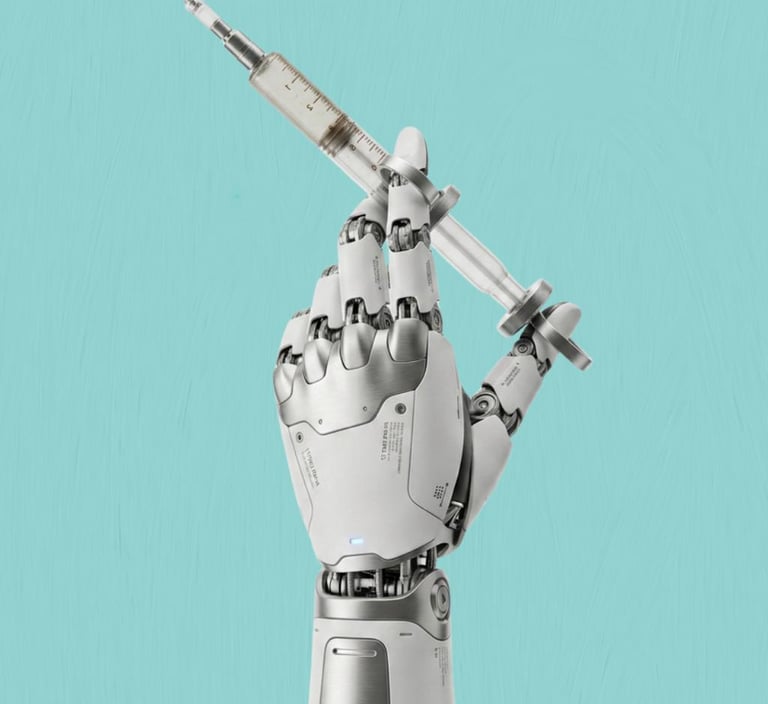
Another advantage of AI tools in plastic surgery lies in its intra-operative phase, in which it reduces operative time, decreases human error, and improves accuracy. In recent years, robot-assisted surgeries have become widespread. In such surgeries, AI algorithms guide robotic arms to conduct intricate procedures with sub-millimeter accuracy. They operate by collecting data from highdefinition surgical cameras or sensors, then processing them using algorithms that interpret motion from the surgeon’s console. As such, surgeons’ hand movements are translated into actions of robotic instruments. For example, an FDA-approved AI tool “Cydar EV Maps” is being utilized during surgery (Novotny et Al.). It uses preoperative and intra-operative imaging to create a real-time anatomical map that helps in identifying and addressing potential complications during surgery. This continuous updating makes up a huge advantage in complex and lengthy operations, where anatomical conditions may change and preoperative images alone are insufficient. Thus, such advancements undoubtedly help surgeons make better decisions.
Another example can be the 365mc Motion Capture and Artificial Intelligence assisted Liposuction (M.A.I.L.) system that is commonly used to aid doctors in liposuction procedures. It works by giving signals to the surgeon’s hand in case of a potential hazardous movement. These signals are haptic (touch-based) and visual; they allow surgeons to make micro-adjustments, increasing the operations’ precision and accuracy. A study showed that “recently developed virtual robotic system has performed significantly better than experienced surgeons in basic surgical tests on pig tissue” (Novotny et Al.)
Hence, these AI-driven tools function as decision-support systems by regularly giving surgeons feedback and alerting in case of hazard to protect the patients’ safety.
Post-operative Advantages:
In the post-operative phase, surgeons depend on AI tools to be able to monitor their patients, assess the outcomes of surgeries, and detect early complications. Some AI machines are also able to produce aftercare recovery instructions. On this topic, members of the American Society of Plastic Surgeons have stated and reported on the following practices: Dr. Roy Kim, M.D mentions that “AI can definitely help with crafting personalized 'aftercare' instructions. I have a template, and then you can plug in the patient's individual issues, and the aftercare instructions are tailored to the patient” (Willson). SinceAI tools assess patients individually and design tailored discharge plans, this can reflect positively on the bureaucratic workload of surgeons and improve the length of stay of patients. Nowadays, discharge planning is a critical issue amid hospital overcrowding, staff shortages, and an aging population, and AI offers scalable solutions to these growing challenges since it presents precise and efficient planning.
Despite the preoperative, intra-operative, and postoperative advantages that AI tools present, its integration still raises privacy and ethical concerns such as patient data privacy as well as the diminishment of the role of physicians.
Patient Data Privacy
The use of AI-driven tools in plastic and reconstructive surgery may pose serious risks regarding patient-data privacy. This is because facial images, body scans, and medical records are used to operate AI systems. These images are confidential and may expose patients to threats of hacking and, unauthorized access. For instance, facial photographs used for facial mapping are identifiable and hard to anonymize, introducing vulnerabilities related to data manipulation/ extraction without explicit consent. Body imaging data also risk being identified especially when scars or tattoos are visible. The storage and processing of these images, whether face or body images, should therefore be responsibly managed to preserve patient privacy and maintain trust in AI-driven machines that assist in plastic surgeries.
Data protection and medical regulations like the General Data Protection Regulation (GDPR) in EU nation-states as well as other places and the Health Insurance Portability and Accountability Act (HIPAA) in the United States have been established in recent years in order to protect patients from data breaches and force surgeons to handle medical images securely.
Diminishment of the Role of Physicians:
The integration of AI-driven tools in plastic surgery has also raised ethical concerns when it comes to the role of physicians. Some fear that with the increasing dependence on AI and robotics, the traditional role of physicians will diminish. As AI systems are becoming progressively more accurate and precise by predicting outcomes, assisting in surgeries, and alerting and suggesting procedural modifications, the risk of shifting from human judgement to AI-backed analysis that of AI is growing. Over reliance on AI-driven tools rather than the physician’s expertise, knowledge, and education is part of the problem. It also hampers the patient-physician relationship and potentially leads to mistrust as patients are being treated by predictive LLMs rather than by experienced surgeons. For these reasons, it is crucial to uphold a balance between new technological advancements like AI tools and traditional methods that rely solely on physicians’ manual abilities. AI should not serve as a replacement, rather it should act as a support to surgeons to minimize their errors and accomplish a higher level of precision and accuracy.
Conclusion:
In conclusion, in today’s digital age, the optimal model of care lies in a balanced integration of both AI systems and traditional methods. Indeed, AI tools offer great advantages when it comes to precision and efficiency, however, over reliance on these machines raises ethical concerns. This is why healthcare systems should focus on integrating AI tools into surgical procedures in a way that supports clinical expertise rather than replacing it. In the field of plastic surgery, AI machines present various advantages ranging from preoperative planning to postoperative monitoring, but these benefits also come with ethical concerns that must be addressed thoroughly. Future research must prioritize developing ethically sound AI systems that ensure patient safety and regulatory frameworks that assert responsible AI use in surgical procedures.
Download the full document
References
Fortune-Ely, M. et al. (2024) ‘The future of artificial intelligence in facial plastic surgery’, JPRAS Open, 39, pp. 89–92. Available at: https://doi.org/10.1016/j.jpra.2023.11.016
Frankeny, A. (2025) ‘How AI is shaping the future of medicine and plastic surgery’, American Society of Plastic Surgeons, 4 March. Available at: https://www.plasticsurgery.org/news/articles/how-ai-is-shaping-the-future-of-medicine-and-plastic-surgery (Accessed: 13 April 2026).
Haider, S.A. et al. (2025) ‘Facial analysis for plastic surgery in the era of artificial intelligence: A comparative evaluation of multimodal large language models’, Journal of Clinical Medicine, 14(10), p. 3484. Available at: https://doi.org/10.3390/jcm14103484
Novotny, M.J., Fast, A. and Radtke, C. (2024) ‘Transformative role of artificial intelligence in plastic and reconstructive surgery: Innovations, applications and future directions’, Artificial Intelligence Surgery, 4, pp. 376–386. Available at: https://doi.org/10.20517/ais.2024.52
Willson, A. (2025) ‘AI-supported plastic surgery planning: Is technology changing the plastic surgery landscape?’, American Society of Plastic Surgeons, 20 August. Available at: https://www.plasticsurgery.org/news/articles/ai-supported-plastic-surgery-planning-is-technology-changing-the-plastic-surgery-landscape (Accessed: 13 April 2026).
Yamamichi, K. et al. (2025) ‘3D simulation accuracy and patient satisfaction with rhinoplasty’, Aesthetic Surgery Journal Open Forum, 7, p. ojaf110. Available at: https://doi.org/10.1093/asjof/ojaf110