Strategizing from 7 cities across the globe

One Piece as a Symbol of Rebellion
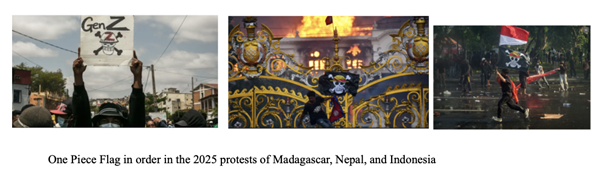
Since the start of 2025, we have become witness to symbolic forms of protesting occurring across the globe. From anime pirate flags to frogs to pikachus, a variety of symbols are deliberately being used in protests and their appearance is only becoming more frequent. Referred to as culture jamming, this act operates directly within these symbolic systems by using cultural icons from corporate logos, national flags, or pop culture imagery, and subverting them to challenge dominant social or political meanings.
CIVIL SOCIETYSOCIAL MEDIASOCIOLOGYDEMOCRACYPOLITICSJOURNALISMTREND
Avery Hazard
2/16/20264 min read
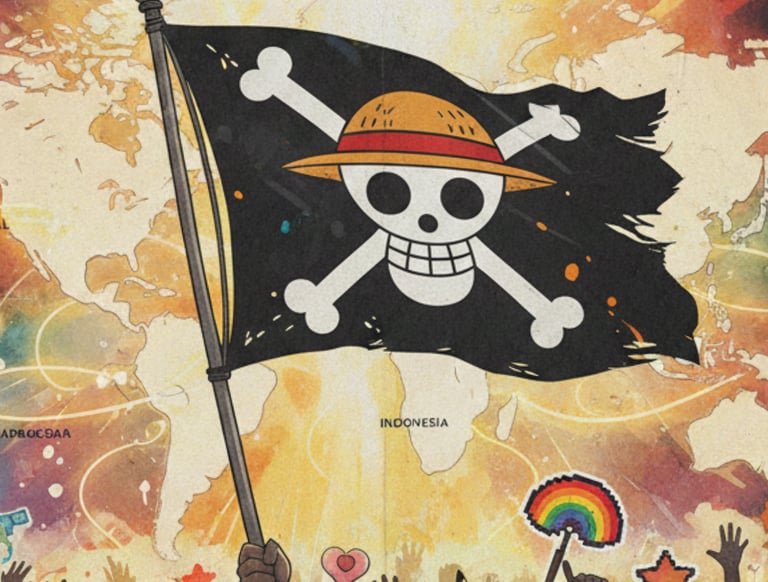
Since the start of 2025, we have become witness to symbolic forms of protesting occurring across the globe. From anime pirate flags to frogs to pikachus, a variety of symbols are deliberately being used in protests and their appearance is only becoming more frequent. Referred to as culture jamming, this act operates directly within these symbolic systems by using cultural icons from corporate logos, national flags, or pop culture imagery, and subverting them to challenge dominant social or political meanings.
Culture jamming is important because it embodies the whimsical and non-threatening side of protesting by showcasing pop culture symbols and dress. Pop culture is incredibly influential because it carries a unique ability to unite people domestically and globally, despite boundaries of language, culture, and geography, by turning familiar symbols that everyone knows into a unitary symbol. Cultural jamming exhibits how pop culture can be repurposed to express real world political values. For example, images are used to draw attention and stir up emotions, and costumes are worn to make rallies appear peaceful and humorous rather than violent. Furthermore, pop culture stands out in rallies that have a global audience, especially when viewers may not fully understand the social and political context that incited the protest. If viewers see certain cultural symbols, they can understand what the protesters are fighting for.
The One Piece flag, or also known as the Jolly Roger flag, is from the manga ‘One Piece’ written and drawn by Eiichiro Oda. The story is centred on Monkey D. Luffy, a young pirate with a rubber body who dreams of finding the legendary treasure known as the One Piece and becoming the Pirate King. The flag belongs to Luffy’s Straw Hat crew and represents their fight for freedom against the World Government and other oppressive pirate lords. Historically, the Jolly Roger flag with just the skull and crossbones flag was flown by pirates during the 17th–18th centuries against the British and other governments. However, each pirate crew in One Piece has its own custom Jolly Roger that symbolises their dreams and values. For the Straw Hat crew, the flag is not a sign of terror but of individual freedom and choice as well as loyalty between comrades. Moreover, in the story, to insult or destroy a crew’s Jolly Roger is one of the greatest acts of disrespect. It is an attack on their identity and freedom itself. Therefore, both flags differ from each other in both design and meaning. Furthermore, originating from a cultural work rather than a political group, the One Piece flag is difficult for officials to censor in any way without drawing accusations of authoritarianism.
In recent protests across all continents of the world, the One Piece Jolly Roger flag has emerged as a tool of culture jamming. When demonstrators wave this flag, they are not simply referencing an anime or trying to glorify piracy in any way. They are invoking the flag’s meanings of freedom, resistance, and unity against oppressive systems which they are actively protesting against. Within the framework of culture jamming, the flag becomes an act of subversion. The flag transforms a piece of global pop culture into a universal language of dissent. In Nepal, demonstrations began after the government imposed a ban on social media platforms. This quickly grew into a movement against corruption and political elitism, which eventually forced the prime minister to resign. In Indonesia, citizens took to the streets to protest against a bill proposed to increase parliamentarians’ housing allowances amidst the country’s high economic inequality. Meanwhile, in Madagascar, protests began in response to water and electricity shortages. These soon evolved into demands for accountability and leadership reform, which led to the president fleeing the country. The Straw Hat Pirates’ struggle against the World Government mirrors the protestors’ struggles against corruption, inequality, and authoritarian control, allowing the flag to bridge fictional rebellion and real-world protest. Additionally, it signals unity among young people inspired by Luffy’s dream to live in a world where everyone can live freely.
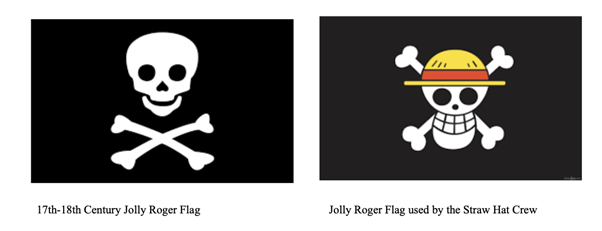
In conclusion, the use of the One Piece Jolly Roger flag shows how important culture jamming is becoming as political expressions in contemporary protests. Pop culture symbols now carry the power to unite people under shared ideals. Through acts of culture jamming, protesters are exposed to familiar icons that critique authority and expose social injustices in ways that are both creative and hard to censor. The One Piece flag, recontextualized from fiction to reality, shows how stories and symbols can transcend borders. Ultimately, the use of culture jamming has taught us that resistance does not always emerge through confrontation alone. Resistance can also be found in culture through humour and imagination. Thus, the One Piece flag’s presence in 2025 demonstrations shows how popular media can be culture jammed into subtle yet potent tools for expressing political discontent.
References
"Editorials: Symbols to Unite That Divide." The Japan Times, 12 Aug. 1999, www.japantimes.co.jp/opinion/1999/08/12/editorials/symbols-to-unite-that-divide/.
Geertz, Clifford. The Interpretation of Cultures: Selected Essays. Basic Books, 1973.
Green, Michael. "How Flags Unite and Divide Us." TED, Oct. 2023, www.ted.com/talks/michael_green_how_flags_unite_and_divide_us?language=en.
Hawkins, Amy. "How the One Piece Manga Flag Became a Symbol of Asia’s Gen Z Protest Movement." The Guardian, 24 Sept. 2025, www.theguardian.com/world/2025/sep/24/how-one-piece-manga-flag-became-symbol-asia-gen-z-protest-movement-liberation.
"How the One Piece Manga Flag Became a Gen Z Resistance Symbol." The Week, 25 Sept. 2025, theweek.com/politics/how-the-one-piece-manga-flag-became-a-gen-z-resistance-symbol.