Strategizing from 7 cities across the globe

Mirroring personalities: a Neurobiological and Behavioral Exploration of Social Imitation and Identity Formation.
Mirroring is a deeply rooted cognitive process involving unconscious imitation of others’ behaviors, emotions, and expressions. While it fosters social bonding and emotional attenuation, excessive mirroring can lead to the loss of one’s innate sense of “self”. In today’s hyper-social world, understanding the neurobehavioral roots of mirroring personalities is crucial, as digital interaction often blurs the line between authentic self-expression and adaptive performance. This study examines both the developmental and psychological dimensions of mirroring, as well as its broader sociocultural implications, including conformity, group identity, and self-alienation.
PSYCHOLOGYHEALTHCAREMENTAL HEALTHNEUROSCIENCEBIOLOGYROOTS
Rita Faraj
1/28/20266 min read
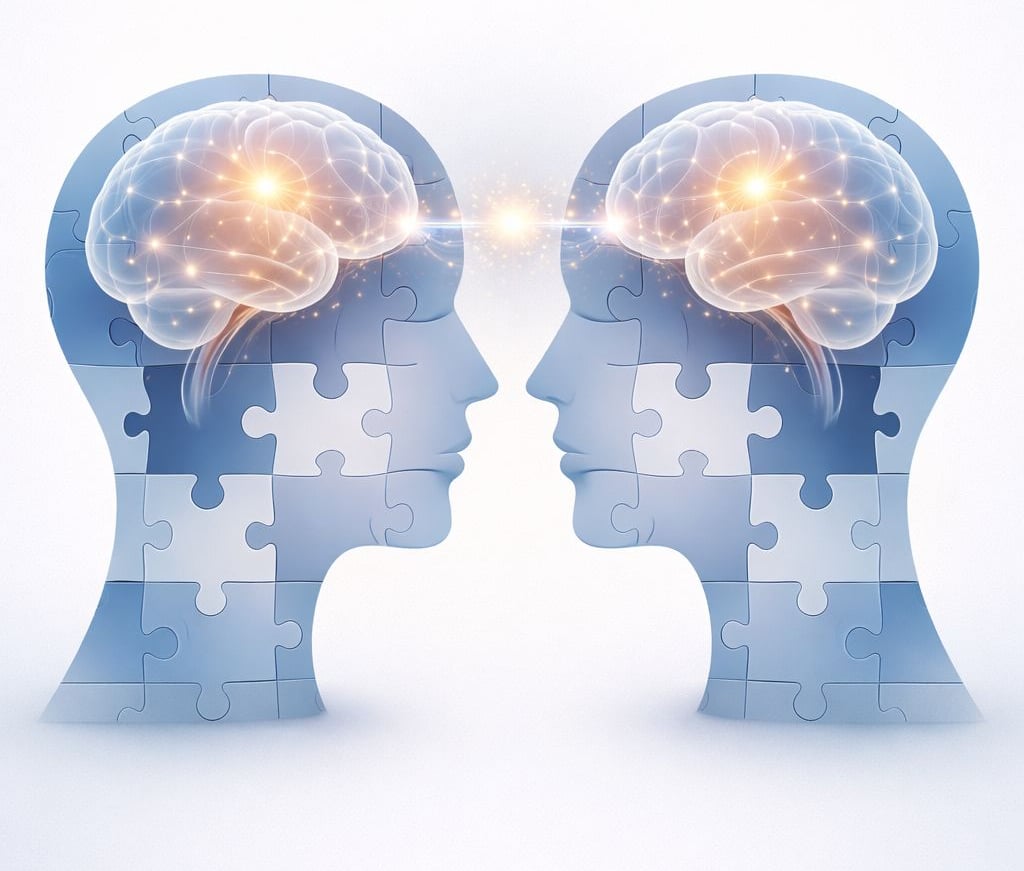
Humans are wired for imitation; unconscious imitation shapes how we learn, bond, and sometimes lose track of who we are. From subtle shifts in posture to the adoption of attitudes and emotions, human beings unconsciously mirror those around them. This phenomenon, known as “mirroring”, arises from the mirror neuron system and represents an overlap between neurobiology and behavior. On one hand, as a form of socialization, mirroring helps us create bonds and establish familiarity in interactions. On the other hand, it can blur the line between one’s authentic self and the many traits unconsciously acquired from the people previously interacted with: the puzzle personality. To explain this paradox, one must pay attention not only to the behavior and cognition aspects, but also to the biological foundations that underlie them. The relevance of mirroring neurons extends far beyond socialization, shaping our “plastic brain”, which is capable of reshaping itself, because it tackles aspects that are found in everyday life. This study examines mirroring through multiple lenses. Psychologically, it ranges from our self-concept and self-identity to the way we feel our emotions, or even create them, extending to how we socially learn and socially reconstruct ourselves. Biologically, it considers the role of neurodevelopment, mirror neuron activity, neuroplasticity, and how the brain-gut axis works in shaping imitation and social attenuation. Clinically, this research surpasses the simple understanding of mirroring, but rather extends to the exploration of its therapeutic potential from imitation-based rehabilitation to interventions in Autism Spectrum Disorders or Borderline Personality Disorder. By bridging psychology and neuroscience, this research aims to reveal how mirroring shapes who we are, its biological roots, and its potential risks and benefits in therapeutic means.
Psychologically, mirroring personalities can be understood through the frameworks of social learning and identity formation. Social learning theory emphasizes that much of human behavior is influenced, more specifically acquired, through observing and imitating others. This essential adaptive process allows individuals to “benefit by copying because by doing so they take a shortcut to acquiring adaptive information, saving themselves the costs of asocial learning” (Laland, 2004). Presumably, copying others has its advantages: “social learners are individuals that live at the expense of the population, exploiting the information, skills, and resources acquired, devised, or discovered through asocial learning, but contributing no new information themselves” (Laland, 2004). Moreover, this tendency continues to shape communications, relationships and empathy, and emotional contagion, allowing people to connect more deeply with one another. Yet these gains raise a question: do they come at the cost of individuality? Over time, constant alignment with external influences can fragment one’s identity, creating what may be described as a “puzzle personality”. If I were to ask you, “Who are you?”, you might describe yourself as an extrovert, an introvert, a nurturer. But if I were to ask, “Why are you the way you are?” the answer would revolve around external factors shaping the way you are. Outside experiences, interaction, have led you to form every little aspect of who you are (Little, 2017). Consider you’re an introvert, sitting with a group of people who are all extroverted: wouldn’t you feel the need to maybe adjust the way you feel and act around them, just so you can match their vibe? And let’s say these people are your colleagues with whom you interact on a daily basis, wouldn’t this little adjustment you made to your behavior get imprinted in your concept of self, and maybe, over time, identify as an extrovert as well? This example illustrates how everyday scenarios shape who we are, and more importantly, why we are this way. Every aspect of the “self” is influenced by the external world and is subject to change. Yet personal authenticity can sometimes be lost beneath layers of borrowed traits. In group dynamics, a person might adopt the aggressive traits of a bully to avoid becoming the one bullied, even if it contradicts their values. This cognitive dissonance, when one’s belief opposes one’s actions, disturbs a person’s sense of identity and forces a change in either behavior or belief. If the person alters their beliefs, their worldview shifts accordingly, often as a result of peer pressure and, therefore, social interaction. This duality, connection versus self-loss, carries both positive and negative effects, making the study of mirror personality particularly significant, leading us to dive into the biological mechanisms behind it.
Biologically, mirroring personalities stem from the mirror neuron system, which enables individuals to map observed actions and emotions onto their own neural circuits. Initially found in the premotor cortex, these neurons enable imitation and empathy, which are essential to social learning. During childhood, these mirror neurons allow the child to learn skills through observation and imitation. For example, consider how children learn to tie their shoelaces: by observing others perform the action multiple times, before repeating the pattern themselves If we look more closely into this, we can attribute this to neuroplasticity, which is the brain's enduring capacity to change and adapt by reorganizing its structure, functions, and connections in response to learning, experience, injury, or other stimuli. Moreover, repeated imitation strengthens neural pathways. Through another lens, we can see how easily individuals “reshape” their “self” by the acquisition of different new observed traits. As Seung explains, what is usually considered “identity” is strongly linked to “the totality of connections between the neurons in a nervous system” (p. xiii), and it is not fixed throughout life. So, “this perspective suggests that identity is not a permanent entity, but rather is subject to frequent transformation, which means that who we are, in terms of how we view ourselves and present ourselves to others, is linked to what we do—how we act, speak, act and think” (Clark, 2017). Beyond structural transformation in the brain, neurotransmitters play a major role in mirroring and personality. These chemical messengers allow neurons to communicate with each other, each serving a different function. Let’s divert our interest towards two key examples, oxytocin and dopamine. Oxytocin acts as a neurotransmitter to regulate social behaviors such as bonding, trust, and love, while dopamine governs pleasure, movement, and reward-seeking behavior, playing a key role in motivation, memory, and mood. If mirroring causes social attenuation and helps build relationships, it can trigger increased release of oxytocin and dopamine in the brain. Consequently, individuals may mirror others more frequently to sustain the rewarding effects of these neurotransmitters and enhance feelings of closeness. Can you see it now? It’s all a reinforcing loop. You engage in mirroring once, it aids you socially, you feel rewarded, so you keep on doing it. Then, neuroplasticity allows you to acquire the trait you were mirroring. So, from the biological aspect, mirroring occurs with the help of mirror neurons and neurotransmitters in order to allow for neuroplasticity to do its work and reshape your “self”.
Finally, let’s talk about the clinical aspect. How can we make use of all this information? The study of mirror neurons has revealed significant implications for understanding and treating various psychological and neurological diseases. Let’s take the case of individuals with Autism Spectrum Disorder, whose mirror neuron system is under activated. This is linked to difficulties in social imitation and understanding others’ intentions. By understanding the relevance of this concept, therapies nowadays use imitation-based interventions to strengthen social cognition for ASD patients, such as mirror therapy, imitation training, and social stories. This therapy technique has been improving mirror responses and enhancing emotional cognition for these patients. Moreover, individuals with Borderline Personality Disorder exhibit structural and functional abnormalities in specific parts of the brain associated with emotional regulation and social cognition. These abnormalities suggest that the neuroplasticity mechanism responsible for shaping these regions of the brain might be impaired (Thornton et. al. 2023). However, understanding neuroplasticity and its effects shows that psychotherapy may help promote neural adaptation and recovery in individuals with BPD. Thus, understanding mirroring mechanisms bridges neuroscience and therapy, allowing professionals to tailor interventions to restore healthy social connections.
In conclusion, unconscious imitation extends far beyond simple everyday actions. It encompasses psychological and sociological dimensions, shaping how we communicate, form bonds with one another, and, at times, lose sight of the “self.” Biologically, it is rooted deep within the nervous system, revealing how the brain forms, processes, and reshapes information. What might seem like a “threat”, can be harnessed therapeutically. Mirror neurons and neuroplasticity can aid in improving impaired brain regions in individuals with disorders such as ASD and BPD. Ultimately, connecting these subtle aspects of our daily life with scientific understanding not only promotes self-awareness and personal growth, but also advances healthcare and therapeutic innovation.
download the full document
references:
Clark, I. Chapter 9: neuroplasticity, genre, and identity: possibilities and complications. Contemporary perspectives on cognition and writing. (2017).
Laland, K.N. Social learning strategies. Learning & Behavior 32, 4–14 (2004).
Little B.R. The surprising puzzle of personality. Who are you, really? (2017).
Seung, S. Connectome: How the Brain’s Wiring Makes Us How We Are. (2012).
Thornton et. al., Borderline Personality Disorder and Neuroplasticity: A Review. International Neuropsychiatric Disease Journal (2023).