Strategizing from 7 cities across the globe

Inheritance Interrupted: The Ethical Dilemmas of Germline Genome Editing in the CRISPR Era
With the rapid evolution of this groundbreaking technology, the selective modification of both somatic and germline cell DNA is no longer science fiction, it is our reality. CRISPR enables the correction of genetic errors and can turn genes on or off in both cells and entire organisms. Its utilization is remarkably quick, relatively simple, and inexpensive, factors that ensure its rapid global spread and societal impact. Such an impressive device holds true potential to further the flourishing of human life, freeing many individuals from life-altering diseases that cause distress to millions of individuals.
ROOTSHEALTHCAREGENETICSBIOLOGY
Rokaya Harajli
1/12/202616 min read
Introduction:
What is humanity’s ultimate end, its highest good, its true path? What is that elusive goal that we labor toward endlessly, always reaching yet never fully grasping? It is our own eudaimonia–our own flourishing in the truest sense, a state that brings about enduring happiness to our kind. This vision of flourishing has long driven humanity’s pursuit of knowledge, science, medicine, and technology. As a species, we have advanced tremendously, reaching new heights that have lengthened our lives, reduced longstanding suffering, and increasingly enriched the quality of our existence. With such strides, we witness firsthand the achievements of science—inventions that continue to give possibilities for human flourishing. Among the endless breakthroughs appears CRISPR-Cas9, a technology once thought impossible, now capable of targeting the fundamental code of our being: our genome. The urgency of these questions has increased in recent years as we witness real-world experiments utilizing germline editing in their practice, stirring global controversy over its many implications.
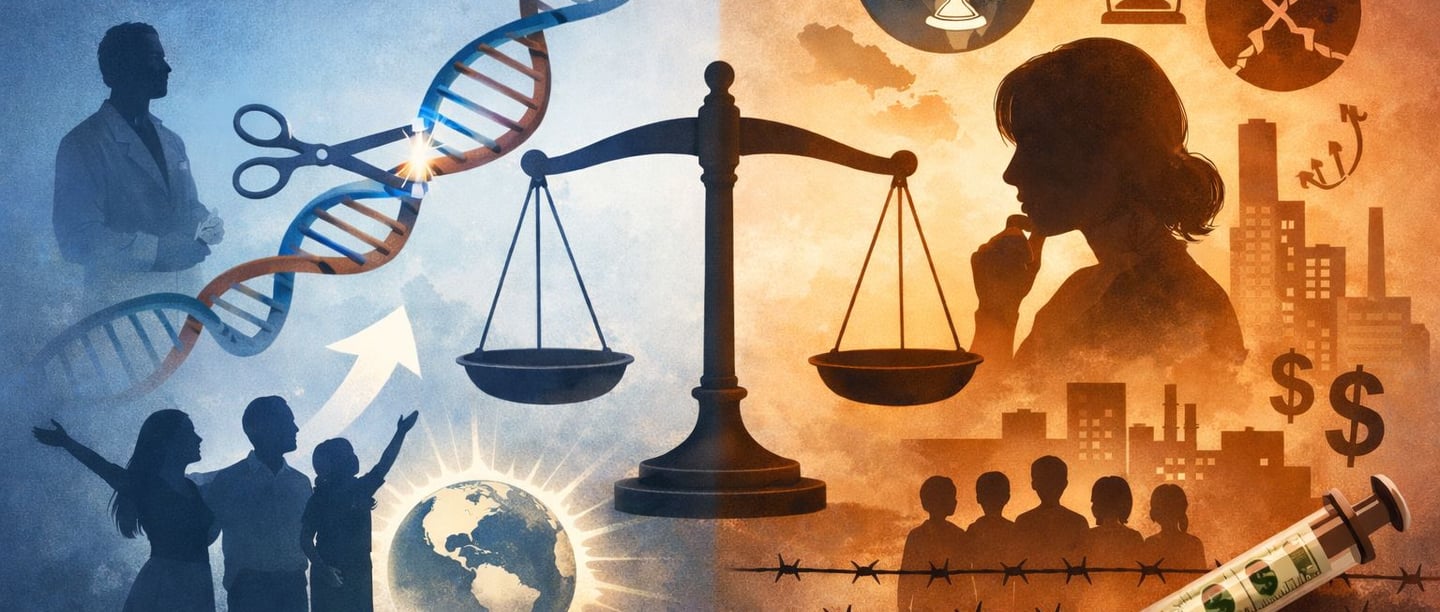
With the rapid evolution of this groundbreaking technology, the selective modification of both somatic and germline cell DNA is no longer science fiction, it is our reality. CRISPR enables the correction of genetic errors and can turn genes on or off in both cells and entire organisms. Its utilization is remarkably quick, relatively simple, and inexpensive, factors that ensure its rapid global spread and societal impact. Such an impressive device holds true potential to further the flourishing of human life, freeing many individuals from life-altering diseases that cause distress to millions of individuals. However, CRISPR remains a double-edged sword, one that can be our salvation, or our demise. This tension is often portrayed in philosophy as a dispute between advocacy and restraint. Julian Savulescu stands for a moral obligation to utilize germline editing to enhance future generations (Savulescu, 2007, pg. 284). On the other hand, critics like Françoise Baylis encourage caution, emphasizing the social, political, and moral risks of altering the human germline. This ethical debate will thus be explored through the lens of molecular genetics, sociology, philosophy, bioethics, and global governance.
Over the years, we have witnessed the scientific community reject the use of CRISPR for editing germ cells, limiting its application to merely somatic cells which conversely cannot be inherited. This stems from various ethical concerns that encompass political, socioeconomic, and humanitarian implications of germline editing. These concerns have ignited an ongoing debate over questions whose answers may present a deciding factor in reducing the never-ending fatalities and suffering of humans due to heritable diseases or genetic vulnerabilities. Can we permit the use of CRISPR for germline editing, and if so, how will it challenge the bioethical foundations of science? What consequences might arise from its global implementation, or its prohibition? Is humanity capable of governing such power without succumbing to corruption, inequality, and harm? All in all, our answers will reveal if we believe human flourishing to be tied to the acceptance of genetic editing or the preservation of our inheritance.
Somatic Vs Germline Applications:
CRISPR-Cas9 (Clustered Regularly Interspaced Short Palindromic Repeats) technology has shown its capability in reshaping multiple domains, evident in cases where edits can be delivered in a reliable fashion. On one hand, in somatic applications, the usage of CRISPR-Cas9 is utilized clinically to modify a patient’s very cells. For example, CRISPR was used to reprogram immune cells to battle lung cancer. On the other hand, it has an impressive role in agriculture, by making targeted edits that modify crops to increase their nutritional value and production. That is, for instance, by making adjustments to ripening in order to extend shelf life (Asmamaw, 2021).
The primary controversy, however, is the targeted cell type. Somatic genome editing is generally accepted and put into practice for existing patients, while germline genome editing continues to be contentious. This is because germline edits are heritable, meaning any mistake could spread over a lineage and eventually wider populations. Additionally, therapeutic somatic edits have an aim of treating diseases (sickle cell anemia), while germline edits might be utilized for the highly controversial enhancement use– “designer babies”—further heightening ethical dilemmas. According to the Nuffield Council on Bioethics, germline genome editing must secure both the welfare of the prospective individual and ensure the continuation of social justice. That is by guaranteeing that no marginalization or disadvantage of groups in society or further separation between social classes occurs, which is accomplished by strict governance and fair access (Nuffield Council on Bioethics, 2018, p. 9).
Still, significant technical risks persist in their association with CRISPR use, directly shaping the ethics of clinical utilization. Editing can exhibit off-target changes, generating safety concerns in therapy. As such, whole genome sequencing and off target assessment for each individual is imperative before clinical use (Tsai & Joung, 2016). Additionally, embryo editing risks mosaicism, in which an individual carries more than one genotype because different cells contain different genetic profiles. This in turn decreases the predictability of variants that will be passed to future generations (Mehravar et al., 2019), thus causing the inheritance of hidden diseases. Altogether, such constraints aren’t mere technicalities, they are precise reasons why restraint and governance are a necessity.
From Therapy to Enhancement, A Moral Boundary:
The fine line standing between therapy and enhancement embodies the collision site of our hopes and our worries. On one hand, therapeutic uses that have the mere goal of preventing severe genetic diseases and unnecessary human suffering seem to honor the basic ethics of medicine; to get rid of suffering and restore function. On the other hand, this exact tool can instead be utilized for enhancement, like selecting traits in the human genome which render an individual with enhanced memory, temperament, athleticism, or beauty. All the previously mentioned options lead to converting human procreation into a design project, capable of further disrupting and worsening various societal aspects associated with class struggles.
Procreative Beneficence:
One of the philosophers concerned with the ability to modify the germline cells of embryos is Julian Savulescu, who presents an argument in favor of such human meddling in the game of chance. Parents, he believes, retain a moral basis to select the “best” child of the probable children they might have, what Savulescu names the principle of Procreative Beneficence (Savulescu, 2007, pg. 284–288). He illustrates the clear distinction between choosing traits ex ante and pronouncing on the value of an entire life ex post; the point he conveys is that we must rely not on hubris, but on logical thinking and the power of reason and foresight. Humans have already started to make selection judgments in IVF by choosing embryos most likely to survive and even going as far as choosing the gender of the embryo; applying that prudence to eliminate serious disease, as he claims, is “playing human,” not playing God (Savulescu, 2007, pg. 284–286). Savulescu believes in uncertainty, in entropy, and in the randomness of life. Nonetheless, he is certain that uncertainty does not qualify as a reason to put the fate of our children entirely in the hands of chance when better-than-chance choices are available for us to pursue (Savulescu, 2007, pg. 286–87).
Savulescu, in my opinion, seems to be operating from a sense of duty that we witness constantly in the theory of Kantianism. His aim is to maximize the probability of happiness for a future human, regardless of any negative consequences that might follow, across various aspects ranging from the individual to the collective. Thus, it is up to us to determine a balance which fulfills our duty to promote healing, happiness, and the preservation of life, while avoiding severe large-scale societal consequences.
Slow Science and Justice:
Françoise Baylis, however, presents a key counterargument. Samantha Noll’s review of Altered Inheritance provides a presentation of Baylis’ argument that considers the various injustices in our world, in which she urges us to take into context prior to any decision on germline editing. Baylis argues that we must open our eyes and use our foresight to understand the kind of world that we are bringing about for our future generations. With that, we must question which groups of people will truly benefit from such legalizations, and which groups will be left behind. She continuously highlights “slow science”, science that has a primary focus on justice and the flourishing of all humans, rather than the economic and political need to be the first. Additionally, Baylis also delves into “impact ethics”, which include values-based, publicly engaged bioethics that aim to implement responsibility and accountability. Therefore, bringing about public empowerment (Noll, 2020, pg. 168–171). With that in mind, even benevolent edits that aim to do good can lead to inequity if it is unbound and practiced inside unjust social structures; “therapeutic” gene editing as it happens can have dangerous consequences if they normalize market logics over shared goods, so what of the possible enhancement gene editing?
I believe that Baylis urges the scientific community to open its eyes to the various separations in our contemporary world; we cannot ignore said gap, the class system, and power struggles. It is a fact that the rush into such an innovation will benefit those who are pushing for it and funding it. These groups of people will hold the power of CRISPR in their hands, contributing to the further separation of “us” from “them”. The “us”, in this case, represents those with resources, power, and money, and “them” represents marginalized individuals, workers, and the powerless. Our world is based on capitalism, and the ungoverned legalization of such a detrimental tool in addition to its existence in the hands of the greedy will have severe consequences.
A Balance of The Ethical Visions:
From both arguments, one must extract a common ground which is the most likely to bring about the highest possible good. Savulescu presents to the reader the individual concern of ensuring a good and disease-free life for our children, as it is our duty to relieve suffering, and CRISPR is the perfect tool for that. Conversely, Baylis addresses what the former did not: the world itself which we will be creating for our children, a world which will have a dire increase in injustice. This fine line between the two philosophers represents the actual work that must be implemented, work that must be regulated and heavily governed so that the story of Alfred Nobel, in which his creation of the explosive dynamite for a practical and good cause of making mining easier ended up creating a weapon used to wreak havoc, does not repeat itself. That is what we must prevent, with all our power, when legalizing the germline modifications using CRISPR.
Clinical and Technical Risk:
On a more immediate front, the risks of germline editing manifests into the physical wellbeing of humans. For example, attempts to modify a specific region of the genome can result in unintended edits at off-target sites. Those off-target edits pose a great risk of unknown mutations that are often hard to detect initially. Consequently, mosaicism may occur, leading to uncertainty in identifying the effects of the genome edit and increasing the risk of patchwork genomes. Such an outcome is explosive in the germline because the consequences can outlive the first germline edited individual and have a ripple effect on future generations, making it uncontrollable. In response to the first claimed case of HIV resistant gene-edited babies in China, led by Dr. He, Vera Lucia Raposo pinpoints the incompleteness of such genome edits on the embryos, the possibility of mosaicism having occurred, and the probability of unvalidated and unpredictable mutations in the CCR5 gene which may not align with the goal of HIV resistance and could conversely have harmful effects (Raposo, 2019, pg. 197–199). Raposo also brings attention to an unforeseen consequence, where the CCR5 is shown to be linked to increased vulnerability to West Nile virus and severe influenza, allowing us to see that “deleting a door” for one pathogen can open doors for various others (Raposo, 2019, pg. 198).
Case Studies:
Another example is that of Denis Rebrikov, who attempted to repair the GJB2 deafness gene in human eggs by following clear guidelines that have been internationally agreed, so no implantation of the eggs into the mothers’ bodies is being done. Denis also explored the limitations and capabilities of CRISPR by experimenting on the eggs, determining if the targeted genes are being accurately reached. Nonetheless, he is still pushing for international support for his project on eliminating the deafness gene in implanted embryos, which is sparking broad criticism worldwide. Criticism centers on the various probabilistic risks associated with germline editing, many of which cannot be definitively determined. Here comes the issue of whether such probabilities, and therefore risks, are worth taking for the sake of advancement. I believe that if such unnecessary human suffering will ensue, not to mention extensive gene alterations with consequences unknown to us that may end up being catastrophic, the current push towards alteration is simply not worth it. Refinement of our technologies such that processes can be made more efficient with minimized risk proves to be an option worth considering before pursuing dangerous ends.
Slow science is that of priceless entailment, and the exact point Baylis illustrates (Noll, 2020, pg.170–171). In the face of the aforementioned severe technical difficulties, it is our duty to weigh the ethical implications. Implications that clearly oppose dire consequences and therefore call for the right-paced science. A science that operates on the basis of true morality and safety, with an end clearly situated in the frame of human flourishing, not merely a race towards advancement.
Another case, which bypassed international laws unlike Robrikov, caused an uproar within the scientific community. It is the previously mentioned case of Dr. He Jiankui in China. Dr. He surpassed regulation and performed germline editing on embryo twins to eliminate their risk of HIV inherited from their father. However, this procedure was not one of tangible success as the modifications did not hit their targets specifically, and their effect is yet to be determined. Dr. He faced consequences for his human experimentation, and many believe that the twins might not be the first he tested on. This, in turn, raises a major ethical concern regarding risk- and error-prone germline experimentation, which may cause harm to the subjects involved. The embryos might develop into babies that are born with several health associated problems that may or may not be observable in their phenotype but are then observed in their future offspring’s phenotype. This introduces genetic diseases that never existed before in the human genome, especially since Dr He’s target was not specifically reached.
This scandalous bypass of international laws set about by the scientific community exposed how easily dangerous experimentation can take place under the table, further displaying the importance of increased governance. Not only that, but Raposo shows how even the motivation behind such secretive experimentation and use of CRISPR was unjustified, seeing as sperm washing and established perinatal protocols rendered the HIV transmission risk as very low, making the supposedly honorable and ethical goal of prevention a mere non-necessity that does not justify the means or risk (Raposo, 2019, pg. 197–99). With that, we can draw about the dilemma of ends and means, where allegedly good ends do not overshadow means that are of high hazard and mysterious generational level mutation consequences (Raposo, 2019, pg. 198–99).
A final illustration worth mentioning is John Zhang’s “three-parent baby”. Showcasing the optimistic side of the coin, where germline editing is not only practiced, but also safe and effective. Zhang and his team used oocyte spindle transfer to prevent mitochondrial disease, which is a disease associated only with the mitochondrial genome of the mother, resulting in the birth of the genetically modified baby. And although he did not utilize the CRISPR technology, the technique edited the heritable mitochondrial genome, giving rise to the idea that germline editing technologies can reach heights of both utility and safety when utilized for medical need and can fulfill the duty to alleviate suffering (Zhang et al., 2017, pp. 529–533). From this, two morals can be drawn. Firstly, therapeutic justification for such complex and heavily consequential procedures is of high importance, where the closer our motivations are to prevent unnecessary harm and elevate human life, the more convincing the ethical case we build for using such methods. Secondly, it is imperative that we give the technologies we are utilizing enough time to progress and advance before allowing their use on germline editing, for it is not a matter of who does it first, but who does it best, as in more safely, effectively, and ethically.
Autonomy and Consent:
With the physical aspect out of the way, it is important to discuss an idea that is very relevant in bioethics: consent and future autonomy. Germline editing bypasses both ideas, as it does not consider the choice which lies in the hands of those majorly affected by such germline editing procedures: the future generations. Here, Savulescu’s focus on ex ante reasons helps in making clear the supposed intentions of one side, the reasonable parents that may see fit to avoid severe genetic disease in their offspring when doing so is safe and feasible (Savulescu, 2007, pg. 284–286). However, by utilizing Baylis’ ideologies, we paint the picture of the other side, the eternally genetically edited individuals who may not have seen justice in such a decision, for it is not just about the mere deletion of a disease, it is about privilege, class struggles, and capitalism (Noll, 2020, pg. 168–171).
The importance of realizing this future autonomy is therefore directly tied to a sense of community, and to the broader society. Noll notes this by shedding light on how Altered Inheritance is not merely individualistic, it is communal in nature and must therefore be built on the basis of reciprocity, equity, and justice. It must be stated plainly; germline decisions are not private goods and must not be a tool in the system of capitalism (Noll, 2020, 170–171). Ergo, where must we draw the fine line that allows the just usage of germline editing by CRISPR? We must recognize first that Savulescu’s idea that uncertainty and probability of dire consequences must not absolve us from choosing, seeing as we choose under uncertainty in most situations in life. Secondly, we must note Baylis' argument, which in turn refines the former, that some decisions are intergenerational and are not an individual choice. Additionally, Baylis plainly lays out the truth of our capitalistic world, where technologies rarely self-distribute equitably, but rather lie in the hands of the wealthy and powerful to contribute to their increasing power. Fast science, as is the case of the race of using CRISPR for germline genetic modification, is merely to increase private benefits over public ones (Noll, 2020, pg. 168–171). Not only that, but the marginalization of minorities will further increase as the upper dominant groups start acquiring biological characteristics that further separate them from the other groups, creating an even greater power struggle between those who own everything and are genetically superior, and those who own nothing and are overridden with diseases and genetic disfavor.
Global Governance:
And with the talk of segregation, geopolitical areas must also be considered when it comes to legalizing the use of CRISPR for germline editions. Reardon notes how global efforts for governance of such a technology exist, such as the WHO registry and the various proposed frameworks, but that is just what they are, proposed. International law between countries is thus still nonexistent (Reardon, 2019, pg. 465–466). This absence of united regulation is the main contributor to the race towards genetically modified humans, where it is still seen as a competition rather than an ethical initiative. This comes from the idea that the first country to be able to successfully produce humans that can be infinitely edited “Super Humans” is one which will hold immense political power. And it is a fact that such a country will not be a third world country, it will be among the countries already in power. This merely fuels political advantage, leading to an even bigger gap between whole cultures worldwide.
Responsible Regulation:
With all the forementioned, how must we move forward with legalizing germline CRISPR editing? We draw that germline therapeutic editing must move forward, if and only if it is built based on equality, the flourishing of all of humanity, the rejection of marginalization and capitalistic class gaps, and the global availability of such a technology, such that it is not only utilized by specific groups. Thus, responsible governance will interlock nonnegotiable elements. The slowing of science to the speed which frees it from unethical capitalistic purposes allows it to properly develop safely and expertly. With that comes the imperative role of transparency and public engagement, where each advancement of this technology is documented and made present to the public, ensuring the possibility of accountability if need be. Reardon’s writing illustrates why registries, open protocols, and international consultations are priceless as they prevent any unethical and opportunistic divergences from the main purpose of CRISPR’s germline editing capabilities (Reardon, 2019, pg. 465–66). With the former, the prevention of cases such as that of Jiankui and under the table illegal experimentation is made possible. Lastly, it is crucial to maintain the main motivation behind any medical technology: to merely increase human flourishing in what is necessary to remove suffering that might pertain to DNA.
Conclusion:
CRISPR, then, is a test not only of scientific capabilities but also of human character. For it is a question of whether mankind can hold such immense biological power without succumbing to corruption. We have seen time and time again the dangers of such advanced technologies when they are utilized for unethical practices or motivations. Zhang’s spindle transfer showcased genomic editing in the best possible light: creative and cutting-edge techniques solely meant to prevent an inheritable mitochondrial disease (Zhang et al., 2017, pg. 529–133). Conversely, Jiankui’s case painted such technologies in the worst possible light, where claimed clinical results were inconsistent with evidence, and necessity was simply not met (Raposo, 2019, pg. 197–199). Our future, therefore, lies in our own making, in our humanity.
All in all, Germline editing encourages our consideration of future generations, for we will be shaping the world for them. With that comes the responsibility to ensure a world that is not bleak, a world that is better than the one we are currently living in. A world where ethics underlie all our actions and choices, especially those associated with our core building blocks, our DNA. It is our duty to ensure that our DNA does not become a weapon to further throw humanity into an abyss of injustice, which we witness readily in our contemporary society. Preserving our humanity must be our goal, and we must do that as we preserve the dignity behind our inheritance, so that editing using technologies such as CRISPR is reserved for necessity, not enhancement and sales value. We can effectively direct CRISPR toward healing and human flourishing if we ensure that it does not become a tool for economic, political, and power advancement. And with that, we give science a bright front which is for the world and by the world. If our resilience ensures this, CRISPR will not interrupt inheritance; it will mend it.
Download the full document
References:
Asmamaw, Misganaw, and Belay Zawdie. “Mechanism and Applications of CRISPR/Cas-9- Mediated Genome Editing.” Biologics: Targets & Therapy, vol. 15, 2021, pp. 353–361. https://doi.org/10.2147/BTT.S326422
Nuffield Council on Bioethics. Genome Editing and Human Reproduction: Social and Ethical Issues. July 2018. Nuffield Council on Bioethics. PDF. https://nuffieldbioethics.org/publications/genome-editing-and-human-reproduction
Tsai, Samuel Quentin, and J. Keith Joung. “Defining and Improving the Genome-Wide Specificities of CRISPR–Cas9 Nucleases.” Nature Reviews Genetics, vol. 17, no. 5, 2016, pp. 300–312. https://doi.org/10.1038/nrg.2016.28
Mehravar, Maryam, et al. “Mosaicism in CRISPR/Cas9-Mediated Genome Editing.” Developmental Biology, vol. 445, no. 2, 2019, pp. 156–162. https://doi.org/10.1016/j.ydbio.2018.10.008
Noll, Samantha. “Altered Inheritance: CRISPR and the Ethics of Human Genome Editing by Françoise Baylis (review).” IJFAB: International Journal of Feminist Approaches to Bioethics, vol. 14, no. 1, 2021, pp. 168–171
Raposo, Vera Lucia. “The First Chinese Edited Babies: A Leap of Faith in Science.” JBRA Assisted Reproduction, vol. 23, no. 3, 2019, pp. 197–199. https://doi.org/10.5935/1518-0557.20190042
Reardon, Sara. “Russian Scientist Edits Human Eggs in Effort to Alter Deafness Gene.” Nature, vol. 574, no. 7779, 2019, pp. 465–466. https://doi.org/10.1038/d41586-019-03018-0
Savulescu, Julian. “In Defence of Procreative Beneficence.” Journal of Medical Ethics, vol. 33, no. 5, 2007, pp. 284–288. https://doi.org/10.1136/jme.2006.018184
Zhang, John, et al. “Live Birth Derived from Oocyte Spindle Transfer to Prevent Mitochondrial Disease.” Reproductive BioMedicine Online, vol. 33, no. 5, 2016, pp. 529–533. https://doi.org/10.1016/j.rbmo.2016.07.008