Strategizing from 7 cities across the globe

Impact of Pop Culture on Public Perception towards Governance and Democracy
Marina daniel
Introduction
In the context of this paper, the term popular (pop) culture is defined as the approval of the public towards a set of cultural goods– such as films, television, radio, or fashion– as per Crosman (2017). This manuscript examines the role of pop culture on public perceptions, attitudes, and choices. While culture provides the foundation to unite a specific group of people through similar characteristics such as language, religion, or values, popular culture is a form of cultural transformation paved by the profound influence of media.
The notion of pop culture was developed following World War II by Bernard Rosenberg and Dwight Macdonald, both of whom held negative connotations and views towards the concept. In their understanding, pop culture contributed to mass alienation and social dehumanization. Such a view was fostered due to the prosperity and restoration of economic health. At that point in time, the United States was characterized by the emergence of a consumer-driven middle class, who were able to financially afford entertainment and leisure activities. Nevertheless, pop culture faced significant critiques, as it was seen as a tool for ideological hegemony, passivity, and conformity.
Intellectuals began to regard pop culture as shallow, manipulative, and even politically hazardous. By the 1970s and 1980s, American popular culture began developing from a form of escapism to a platform for political and social commentary. Films, television, and music addressed issues like civil rights, war, corruption, and inequality. Yet, the more pop culture tackled important and serious themes, the higher skepticism grew about its legitimacy as a political force. People wondered if media representations could legitimately inform or, instead, distort public knowledge.
Such cynicism was particularly driven by the increasing overlap between entertainment and politics. Cultural critic Neil Postman, in Amusing Ourselves to Death (1985), warned that mass entertainment and television were transforming serious public discourse into spectacle, eroding the space for democratic deliberation founded on reason. He argued that when politics becomes a form of entertainment, the public grows less active, more cynical, and less capable of distinguishing image from substance.
Research Questions and Hypotheses
Popular culture holds an immense degree of power to influence perspectives such as political, sociological, religious, or economic stances. Hence, pop culture strongly affects the cognitive and behavioral patterns of social capital and the whole mindsets of societies and communities. With the aim of exploring the nature of such influence, this research explores a set of key questions:
How influential is pop culture on public opinion?
Does pop culture threaten elites and decision makers?
How has pop culture shaped the global public’s understanding of democracy?
The paper follows a null hypothesis that involves statistical testing holds the below hypothesizes:
H1: Pop culture is a tool of soft power that holds the power to direct the public’s choices.
H2: Pop culture is a tool of soft power that can only provoke the public’s cognition.
H3: Pop culture threatens elites and decision makers.
H4: Pop culture has undermined the global public’s understanding of democracy by increasing mistrust in democratic institutions and leadership
The paper analyzes two films: first, The Bibi Files, which displays allegations of corruption against Israeli Prime Minister Benjamin Netanyahu using leaked police interrogation footage. Second, The Apprentice, which demonstrates the rise of Donald Trump into the world of business and real estate. The paper goes further to analyze how the American public has interacted with both films in regards to their perception, attitudes, and political choices.
Theoretical and Practical Significance
The study contributes to a growing body of interdisciplinary research that connects between media studies and political communication.
From a theoretical perspective, the study explores how entertainment media hold a significant degree of power to influence public political perceptions. It also bridges the gap between popular culture and civic consciousness.
The study also provides practical significance, as it serves as a reference for media practitioners, educators, and civil society actors on several fronts. First, the study may be used to address how the media can contribute to public radicalization or disengagement. Second, it allows scholars to understand the mechanics behind the erosion of trust.
Conceptual Framework
The conceptual compartment of the study clarifies and defines key concepts such as pop culture, public political perception, political attitudes, political choice, and understanding of democracy.
Pop Culture
Several scholars have found it difficult to define the term ‘culture’. Pereira and Cachola (2019) analyze the concept of popular (pop) and its association to culture. On one hand, in their understanding, popular refers to anything that is widely accepted and favored. On another hand, Williams’ definition (1983) suggests that pop culture is something that is made by the people for the people. Amid several complementary and contrasting definitions, the notion of pop culture has increasingly gained popularity. It is, however, important to note that the term is not a fixed one, but rather an ever-evolving construct.
The notion of pop culture was developed in the United States following the second World War by several authors, namely Bernard Rosenberg and Dwight McDonald. According to them, pop culture is the privilege of a high-class minority who were able to produce and market their views through several mediums. This view, however, disregards human agency and assumes the passivity of the rest of the population.
For the purpose of this study, I am defining pop culture as mass media– in this case, films– that are widely consumed and socially influential. More specifically, the study focuses on two politically themed films– The Apprentice and The Bibi Files – which have served as cultural mediums for raising political awareness.
Public Political Perception
Perception refers to one’s own views and understanding at a given point in time. According to Dowler et al. (2006), people’s views are the sum of social interactions. In other words, the more people voice and discuss their thoughts and opinions, the more they are shaped and influenced. Perception, which shapes behaviors, is usually challenged or reinforced by others’ views.
In accordance with the scope of this study, I shall build on the view shared by Sadri and Flammia (2014), as they define political perceptions as the process through which people develop impressions of characteristics and positions of other actors or foreign policies. This process is highly influenced by the media; in most parts of the world, people use and trust the media (TV, Radio or Newspapers) as their primary source of information.
Political Choice and Democracy
In its raw meaning, political choice refers to the ability of individuals to make decisions based on sound evaluations. Hobot and Hoernr (2020) argue that this process, where the public is empowered to choose between alternatives, is the core of what democracy symbolizes. Hence, political choice is the outcome of the sum of public perceptions shaped by different tools of socialization.
Macedo (2005) emphasizes that democracy is at risk due to the significant extent of political abandonment among citizens. Declining levels of civic engagement are threatening democracy. Therefore, the government has started to consider teaching civic education in schools. To define civic engagement, it is the choice to engage or disengage in any political activity. This choice is guided by the amount of trust that the public has in its rulers. The higher the trust, the more people would be willing to engage, and vice versa.
Methodology
Case Selection
As previously mentioned, the study focuses on two political popular culture films: The Apprentice and The Bibi Files. These films were deliberately selected using purposive sampling techniques, as they hold cultural prominence and political influence.
The Apprentice is selected as a unique case due to its release date, which occurred shortly before the second round of President Donald Trump’s election in late 2024. In light of this, examining public perception, attitudes, and behavior is of most relevance. As for The Bibi Files, it offers a critical media perspective on political power in a different context (Israel), allowing for a comparative analysis on how pop culture may generate distrust among the public.
Through both cases, this study portrays the power of pop culture to contribute to public cynicism, erosion of democratic trust, and distorted civic understanding.
Data Collection Method
Data was collected through discourse analysis, whereby scenes from both movies will be selected with the goal of identifying how power and leadership are framed through language and symbolism.
Additionally, social media discourse was utilized, whereby online reviews and news commentary surrounding both films were analyzed to understand the wider cultural narratives. Furthermore, a structured online survey was distributed to diverse participants globally. The main goal of the survey was to assess the public’s attitudes towards engagement in politics and the perceived influence of the media.
The quantitative method uses a surveying approach to analyze public perception, attitudes, and choices with respect to the two movies. Hence, the survey is limited to participants who have seen one of the two movies, at least, or both. This allows the researcher to not only draw a conclusion about public attitudes towards public policy, but also about global public opinion. The survey was filled by a random sample of 10 respondents from different countries, namely the United States of America (USA), Portugal, Canada, and the Arab Republic of Egypt.
Data Analysis
Since this study aims to assess the impact of political films on the public’s perception, attitudes, and choices, it demands a mixed method data analysis approach. To understand how experiences are shaped by the surrounding social and economic contexts, the study uses contextual and narrative analysis. More specifically, the narrative analysis seeks to explore how figures in power make decisions, interpret events, and construct their identities. Also, the survey responses are analyzed through descriptive statistics.
It is worth noting that the survey form was directly distributed to over 100 potential respondents from the USA and indirectly disseminated to social groups that host over 10K participants. Nevertheless, it has come to my attention that both films were not accessible to USA residents. Platforms have strictly prohibited their screenings, as explained in the sections to come.
Research Findings
Who manages Pop Culture?
Pop culture is formed in a contested space, where it is neither top-down-led nor bottom-up-influenced all the time. Cultural elites, such as producers and state institutions, often dictate what gets produced, funded, and distributed. On one hand, a top-down hegemony is often keen to shape ideological narratives in a way that reinforces the status quo, whether that is a specific class, capitalist economy, or gender roles. Antonio Gramsci labels this as a cultural hegemony i.e.an attempt to maintain power, not only by enforcing laws and force, but also by controlling cultural norms and consent (El Aidi and Yechouti, 2017).
Nevertheless, the masses typically resist this cultural hegemony, through independent films and digital platforms, to reclaim narratives, provide alternative visions, and expose contradictions. For the two films under investigation, it is important to investigate their production journeys and how they have come about.
Firstly, The Apprentice is directed by Ali Abbasi, an Iranian born filmmaker. Brzeski (2024) wrote in The Hollywood Reporter about a campaign launched by Trump threatening to sue Abbasi over the movie. In response, Abbasi claims that there is no nice metaphorical way to address the rising wave of fascism – only a messy way. He adds that the problem with today’s world is that good and fair people have been silent for too long. Therefore, it is time to make relevant films and it is time to make them political again. To add, although the movie did not have a U.S distributor, it has made its way to the Cannes Film Festival. It is important to note that the movie was released just before the 2024 U.S. presidential elections, which may have prompted Trump to take measures to limit the film’s publicity and promotion.
Secondly, The Bibi Files was directed by Alexis Bloom - who happens to be a South African filmmaker. It is worth mentioning that South Africa is the first country to call the International Criminal Court (ICC) to issue an arrest warrant for Israeli Prime Minister Benjamin Netanyahu. In an interview with Bloom, she reveals that the movie has been pirated several times. She states, “When the movie was screened in Toronto, Netanyahu went to court, trying to block it. He really does not want anyone to see it”. In fact, the movie continues to face a difficult time in becoming accessible to everyone– it has not yet had the chance to make it to the United States, several countries in Europe, or Israel itself.
In light of the challenges faced by both films to make it to screening, it may be inferred that elites remain in control of what they want people to see. Although masses try to push for the dissemination of real information and awareness among different communities, restriction and oppression remain prevalent.
How did Pop Culture shape Public Perceptions, Attitudes and Choices?
Moreover, the research focuses on a survey shared among Middle Eastern, American, Canadian, and European communities via different social media groups, reaching approximately 2,000 individuals. However, some respondents communicated that they were unable to access the movies. While certain participants had heard of the films and attempted to find them online, they were unable to find a functioning streaming link. Only ten respondents were able to view the movies; seven from Egypt, one from Portugal, and two from the United States who watched the film while visiting Lebanon.
Accordingly, the findings presented in this section are based on responses from ten survey participants. The survey explores participants' perceptions of both films regarding the accuracy or potential bias in the portrayal of the main character. It further examines the level of trust that individuals maintained towards political leaders after viewing the films. Additionally, the survey evaluates public attitudes towards engagement with the news media, political parties, and electoral participation.
With respect to the validity of the storylines in the two movies, all of the survey respondents held the view that both The Apprentice and The Bibi Files presented fair depictions of their respective leading characters.. To the issue of whether watching the movies had decreased their confidence in political leaders, 66.7% of respondents responded that their confidence level had not changed, while 33.3% felt that their confidence had decreased. As far as behavioral change towards political engagement, 66.7% of respondents said that they would consciously go out of their way to exclude themselves entirely from viewing political content in the future, suggesting a potential distance from political discourse. Meanwhile, 33.3% expressed no change in viewing behavior. Despite these variations in trust and political participation, one may reach a certain consensus based on the results: all participants agreed that the films had increased their critical awareness of democratic processes and skepticism regarding politics. This implies that the films succeed in raising critical awareness, even if the outcome comes hand in hand with increased skepticism towards politics and political actors.
The majority of responses reflect several underpinnings. First, the unanimous agreement that both films have increased awareness about democracy and cynicism suggests that films, as core elements of pop culture, are powerful mediums for political education. Yet, the fact that cynicism is on the rise indicates that there is a clear paradox between awareness and engagement. Awareness does not necessarily translate to active engagement but can rather discourages it. Second, since 100% of respondents linked the films to increased political cynicism, it is evident that both political figures were negatively depicted – which eroded faith in political processes. Third, declining public attitudes towards politics imply that pop culture influences behavioral engagement more than belief-based trust can. Fourth, although participants became more aware of the existing political flaws, the absence of pathways for constructive action, rather than increased participation, may be the real reason for their withdrawal from political content. A sense of agency to act is dependent on the viewers’ perceptions and interpretations of the message itself.
Conclusion
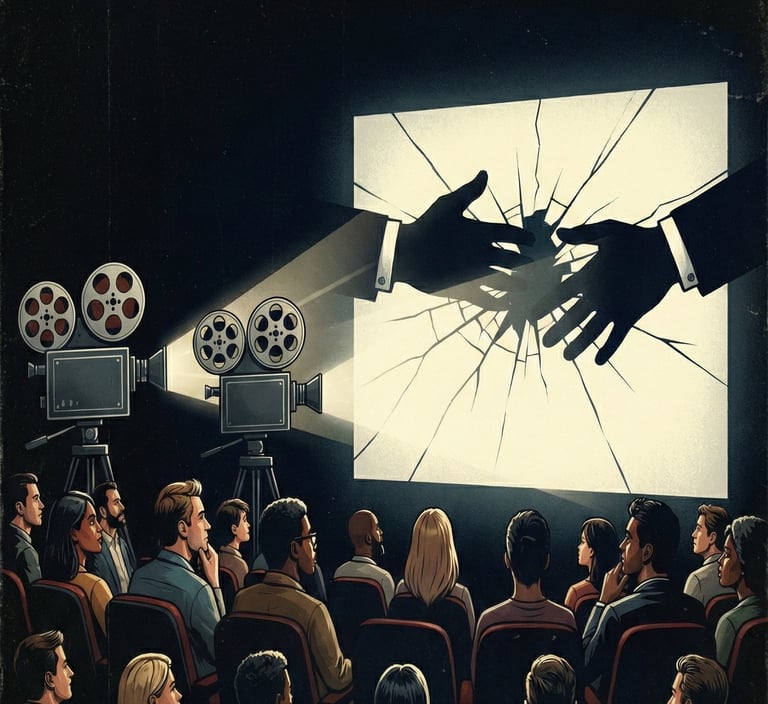
To conclude, the research sought to examine the role of pop culture as a soft power that has the ability to influence public perception, attitudes, and behavior toward democracy, focusing on the films The Apprentice and The Bibi Files. The findings support the hypotheses shared earlier that pop culture, when employed in the form of high-impact narrative media, has the ability to reframe public cognition, undermine elite narratives, and sway trust in democratic institutions.
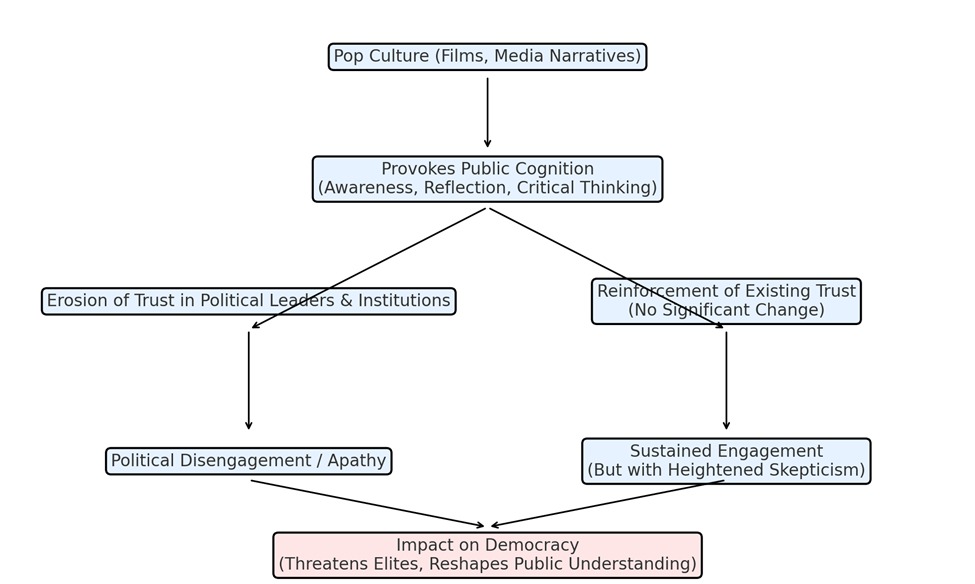
The findings show that all the respondents agree that each film best captures their main characters, and, therefore, achieved high perceived authenticity. However, in reality, authenticity is not proven equally as a behavioral consequence. It has been clear that the majority of the respondents indicate no alteration in existing levels of trust. More concerning, though, was the finding that two-thirds of the sample (66.7%) said they intended to avoid political content altogether once they had viewed the films. This indicates that, while pop culture narratives have been successful at generating awareness and critical thinking (increasing democratic consciousness), they are also capable of generating political disengagement when the content is perceived as disillusioning and disempowering.
First, these results indicate the contradictory function of pop culture as a soft power. On one hand, it acts as a counter-hegemonic force, disrupting elite-dominant narratives and uncovering systemic vulnerabilities, thereby "threatening" established political elites. On the other hand, it destabilizes the very democratic participation it claims to foster by discrediting institutions without providing apparent avenues for constructive action. This is in line with the broader literature on political communication and media effects , which warns that rising political cynicism in the absence of political efficacy usually results in apathy, not mobilization.
Second, the study refutes the notion that pop culture is completely elite-controlled. Although elites possess profound influence over the production and distribution of pop culture, the reception of these films shows that audiences both interpret and internalize the message in a manner that can deviate from, or even counter, intended meanings. The potential of The Apprentice and The Bibi Files to create mistrust and critical thought—even had such ramifications been independent from elite interests—demonstrates that popular culture remains, though sometimes imperfectly, a contested ground in the struggle for creating public meaning.
Lastly, this study demonstrates that popular culture is not an apolitical entertainment space, but rather a formidable tool that wields the soft power to influence public decisions and mindsets. Its strength is most evident in its ability to provoke thinking, or, in other words, challenge viewers to question and reconsider their political world. However, when that provocation does not incorporate channels for agency, it may actually undercut democratic knowledge by replacing active participation with passive cynicism. For policymakers, media producers, and civic society representatives, these findings suggest that a more intentional and positive framing of political pop culture stories is necessary to prevent distrust in flawed leaders from spreading to the entire democratic process itself.
In summary, the study reaches the below theoretical understanding of how pop culture may eventually affect democracy:
Download the full document
References
Brzeski, P. (2024). ‘The apprentice’ director shrugs off Trimp lawsuit threat: “Everybody talks about him suing a lot of people, they don’t talk about his success rate”. The Hollywood Reporter. Retrieved from: https://www.hollywoodreporter.com/movies/movie-news/cannes-the-apprentice-trump-lawsuit-ali-abbasi-1235904897/
Crosman, A. (2017). Sociological Definition of Popular Culture: The History and Genesis of Popular Culture. Retrieved from: https://www.thoughtco.com/popular-culture-definition-3026453
Dowler, E.; Green, J.; Bauer, M. (2006). Assessing Public Perception: Issues and Methods. Retrieved from: https://www.researchgate.net/profile/Martin-Bauer-2/publication/30528118_Assessing_public_perception_issues_and_methods/links/00b7d530b0ca10e79d000000/Assessing-public-perception-issues-and-methods.pdf
El Aidi, A. And Yechouti, Y. (2017). Antonio Gramsci’s Theory of Cultural Hegemony in Edward Said’s Orientalism. International Multidisciplinary Research Journal, Vol 6(5).
Hobolt, S. and Hoerner, J. (2020). The Mobilizing Effect of Political Choice. European Journal of Political Research, Volume 59. Retrieved from: https://ejpr.onlinelibrary.wiley.com/doi/pdf/10.1111/1475-6765.12353
Macedo, S. (2005). Democracy at Risk: How Political Choices Undermine Citizen.
Pereira, S., & Cachola, A. C. (2019). The Question of Popular Culture. Diffractions, (4), 1–10. https://doi.org/10.34632/diffractions.2015.489
Postman, N. (1985). Amusing Ourselves to Death: Public Discourse in the Age of Show Business. Penguin Books.
Sadria, H. And Flammia, M. (2014). Democracy, Political Perceptions and New Media. System, Cybernetics and Informatics, Volume 12(3).
Williams, R. (1983). Keywords: A vocabulary of culture and society. New York: Oxford University Press